
Recent events including the continued killings of unarmed Black people by law enforcement and the disproportionate rates of COVID-19 cases in Black and Hispanic communities once again shed light on the deeply embedded systemic racism in this country and its institutions. It is important to recognize that People of Color often experience significant trauma as a result of these past and present realities, some of which we’ve explored throughout this challenge. Research has linked racism to psychological distress, physical health problems, depression, and anxiety—symptoms similar to those with post-traumatic stress disorder (PTSD). The internalization of bias and oppression can cause great distress to minds, bodies, and spirits.
“It is important to consider the compounding impact of belonging to multiple marginalized and oppressed groups, including (but not limited to) race, gender, and sexuality, and how these intersections interact and increase susceptibility to experiences of racial trauma.” (University of Georgia)
Intersectionality, a term coined by Kimberle Crenshaw in 1989, describes the ways in which many social justice issues including racism and sexism are often overlapping, creating multiple levels of injustice. It is important to consider the “effects of racial trauma through the lens of intersectionality because this allows for a more thorough account of the multiple identities occupied by Black Americans (e.g. Black trans women, Black differently-abeled Americans, etc.) and how those who occupy multiple identities are impacted by racial trauma.” (University of Georgia)
Dr. Monnica Williams of the University of Connecticut notes, “what we really need is a large-scale shift in our social consciousness to understand the toll this takes on the psyche of victims so that even small acts of racism become unacceptable. We need those who witness racism to speak out and victims to be believed.”
Today’s Challenge
Read
- Read this short article by Dr. Williams to better understand the effects that racism can have on mental health. https://www.psychologytoday.com/us/blog/culturally-speaking/201509/the-link-between-racism-and-ptsd
- Read this list of 8 ways to practice self-care when you are personally affected by racism. https://www.huffingtonpost.ca/the-conversation-canada/racism-mental-health-self-care_a_23427584/
Engage
- Explore this list of mental health resources for Black, Indigenous and all people of color. https://www.naminh.org/resources-2/bipoc/
Discuss
- The term “intersectionality” gives us a way to understand the oppressions and privileges that overlap and reinforce each other. Why could this be useful when working to advance racial equity and social justice? How do you see intersectionality relating to the people in your life/the people in your community?
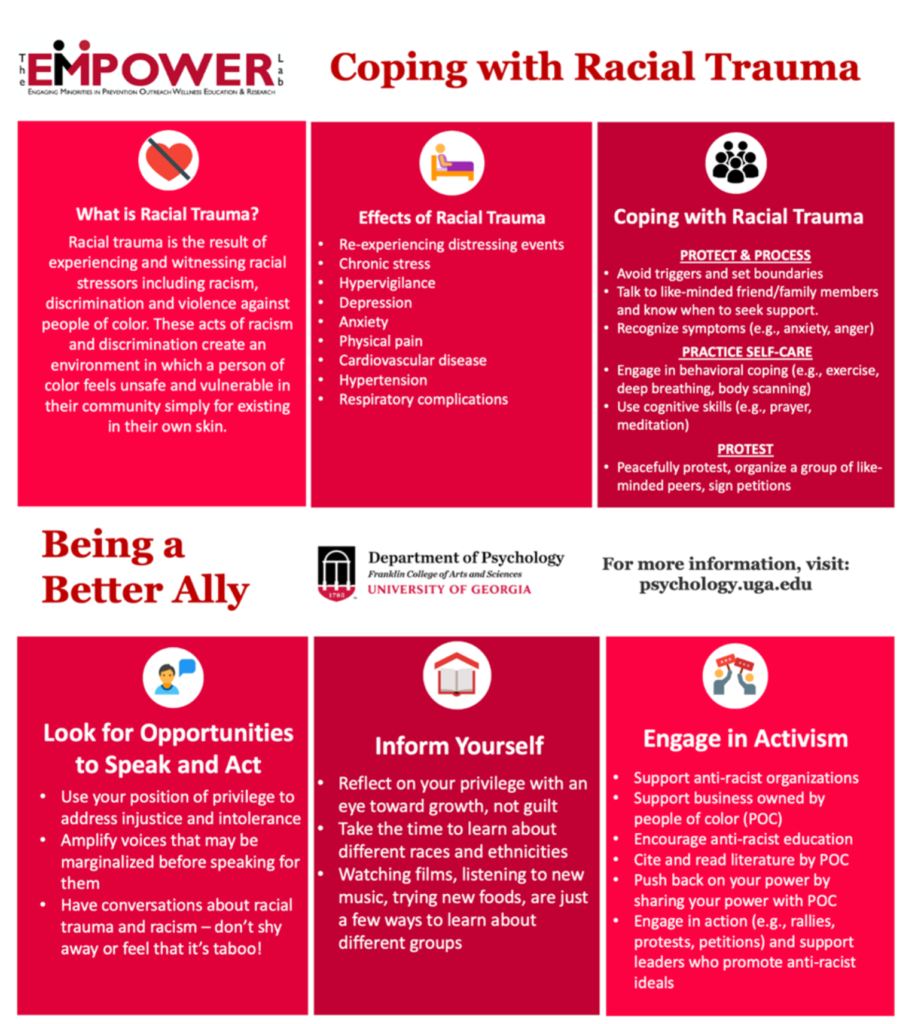
- As Dr. Monnica Williams points out, our society needs a large-scale shift in our social consciousness to understand the toll that racism takes on the psyche of Black, Indigenous, and all people of color so that even small acts of racism become unacceptable. What did you take away from the Empower: Coping with Racial Trauma graphic?