Today the Michigan Association of United Ways, in collaboration with United For ALICE, Consumers Energy Foundation and local United Ways statewide, released an updated report on financial hardship among Michigan households. ALICE stands for Asset Limited, Income Constrained, Employed – individuals earning above the Federal Poverty Level yet struggling to afford basic expenses. The latest report, titled “ALICE In The Crosscurrents,” includes data from 2021-22.
Jen Hsu-Bishop, Executive Impact & Equity Officer for United Way of South Central Michigan (UWSCMI), shared local and six-county regional findings:
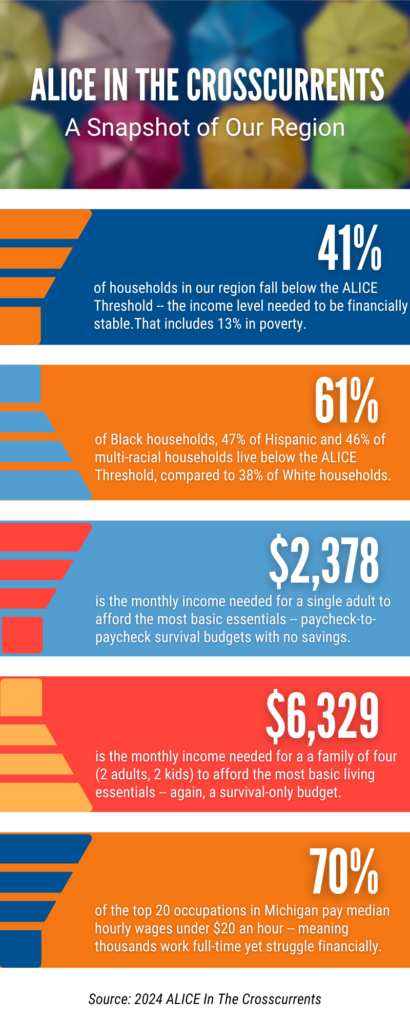
- 41% of households in the region fall below the ALICE Threshold, which is the income level needed to be financially stable. The number of households in poverty remained relatively stable at 13%, but those in the ALICE category – above poverty but below the threshold – increased by two percentage points, to 28%.
- Financial hardship affects different demographic groups differently. Black (61% below the ALICE Threshold), Hispanic (47%) and multi-racial (46%) households are more likely to fall below the ALICE Threshold than White (38%) households. Likewise, single-headed households with children, those headed by adults under age 25, and those headed by adults 65 and older are also more likely to struggle financially.
- The cost of living is outpacing income. A single adult in the region must earn $2,378 every month to cover the most basic of needs. That equates to a full-time hourly wage of $14.27. A family of four, with two adults and two children, needs $6,329 every month to meet those basics. That’s a full-time hourly wage of $37.97. These are paycheck-to-paycheck survival budgets, where one unplanned expense can send a household into poverty.

“To be financially stable, which means being able to cover basic needs plus build some savings, a single adult in our region needs $4,104 every month. That’s a full-time hourly wage of $24.62,” said Hsu-Bishop. “A four-person family needs $10,952 monthly, or $65.71 an hour, to be financially stable.
“Yet nearly three-quarters of the top 20 occupations in Michigan pay less than $20 an hour. That means thousands of people in our communities are working full-time but don’t earn enough to make ends meet. Clearly there’s a great deal of work to do.
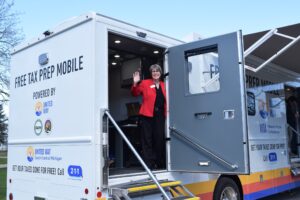
“At United Way, we’re bringing together the resources and partners to move that work forward, both locally and regionally. That includes our Program Assistance Center that connects people to utility assistance, and our Volunteer Income Tax Assistance program that provides free tax preparation, and our Continuum of Care activities that make sure families have a roof over their heads, and so much more,” Hsu-Bishop added.
Chris Sargent, President & Executive Officer of United Way of South Central Michigan (UWSCMI), offered the following insights and perspective on local and regional ALICE data:
“The new ALICE report paints a sobering picture of financial hardship in our local communities. That’s a picture of real people – people we rely on every day. ALICE includes neighbors, family members, the local barista and fast-food cashier and personal care aide. ALICE spans all races, all ages, all ethnicities and all abilities. They’re hard-working people, sometimes even holding down two or more jobs, but living paycheck to paycheck.
“While these numbers are troubling, they barely begin to describe life for ALICE. Individuals and families are making impossible choices every day. Food or rent? Medical care or child care? Heat and light at home, or gas in the car? No one should have to make those kinds of decisions. As caring communities, we cannot be okay with this.
“Our United Way has made a firm commitment to addressing the needs of financially struggling people in our communities, with an intentional focus on populations with the highest rates of ALICE.

“We’re doing this through initiatives and partnerships that improve conditions so ALICE households can move from survival to stability; that fill gaps and reduce disparities in meeting basic needs; and by building a stronger United Way that’s equitable, efficient and reflects a community of care.
“We’re hopeful that a future where every person is valued, thriving and connected for the common good is achievable. Getting there will take a collective, concerted effort. We invite our communities to join us to accelerate that journey.”
The full text of the Michigan Association of United Way’s announcement on the new ALICE report is available at uwmich.org/alice-report. You can also download a summary of the Michigan data here. More details from the latest ALICE report, including additional local and regional data, are at unitedforalice.org.