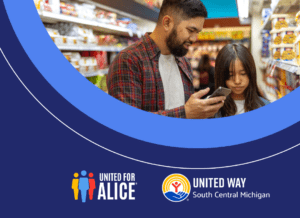


When communities want to understand how local households are doing financially, they often check the poverty rate. But that doesn’t give the full picture of how many individuals and families struggle to make ends meet.
“ALICE encompasses what was once described as ‘the working poor,’ but it stands for much more than that,” said Laurel Clark, Associate Director of Community Impact for United Way BCKR.
“ALICE helps us better understand the people and the many variables in their lives—from basic living needs to the many barriers that keep them from getting ahead,” Clark added. “By factoring in these elements, we gain a better awareness of where the challenges lie and what we can do as a community so every person has the opportunity to become financially stable.”
The Michigan Association of United Ways has issued four comprehensive ALICE reports, the most recent one last month. Here’s what the latest report told us about the Battle Creek and Kalamazoo region:
- 39% of households fall beneath the ALICE threshold—the level where they can be financially stable. Some 14% of households in the region are in poverty.
- Among Hispanic households in our region, the percentage under the ALICE threshold jumps to 51%, and for Black households, it’s 64%.
- Cost of living is rising faster than wages, making it harder for people to keep up. Low-wage jobs dominate the employment landscape.
- More wage earners live barely above the ALICE threshold. They are at risk of slipping below it, especially as we still wrestle with the economic effects of the pandemic. Indeed, the new report covers 2019, meaning the impact of COVID-19 will almost certainly make the plight of ALICE worse.
Clark said the ALICE data brings critical information to nonprofits, policymakers and others who are trying to address financial instability.
“The Michigan Poverty Task Force relied heavily on this data in their recent report, identifying ways to reduce poverty and help struggling families succeed,” said Clark. “Locally, we can see how financial instability weaves through our impact work and long-term community goals. That’s influencing new strategies and partnerships as we strive to accelerate our impact.”
What can you do? Get to know ALICE better; you’ll find a list of our past blogs here. Read the Michigan Poverty Task Force’s report and consider writing your state legislators to support its policy recommendations.