
Championed by communities of color including African Americans, Native Americans, Latinos, Asians, and Pacific Islanders, the environmental justice movement addresses a statistical fact: people who live, work, and play in America’s most polluted environments are disproportionately People of Color and low income. This is no accident. Communities of color are routinely targeted to host facilities that have negative environmental impacts. The statistics provide clear evidence of what the movement rightly calls environmental racism (source).
Despite wanting the best for their families, people with limited means are often less geographically mobile, and have fewer affordable choices when deciding where to live. And often, their voices are not heard in society’s decision-making process. This has led to residents with low incomes, and often People of Color, living in areas with high rates of air and water pollution, such as in industrial areas, near highways, or near toxic waste sites.
Studies have shown that People of Color are exposed to more pollutants than White people.
Pollution and particulate matter exposure have been linked to asthma, low birth weights, high blood pressure, and other adverse health outcomes.
Dr. Mona Hanna-Attisha, an Associate Professor at Michigan State University, used science to prove that children in Flint were exposed to lead and went public with her findings to bring light to the crisis. Her book, What the Eyes Don’t See is her first-hand account of how the crisis unfolded. Watch her TEDMED talk to learn more.
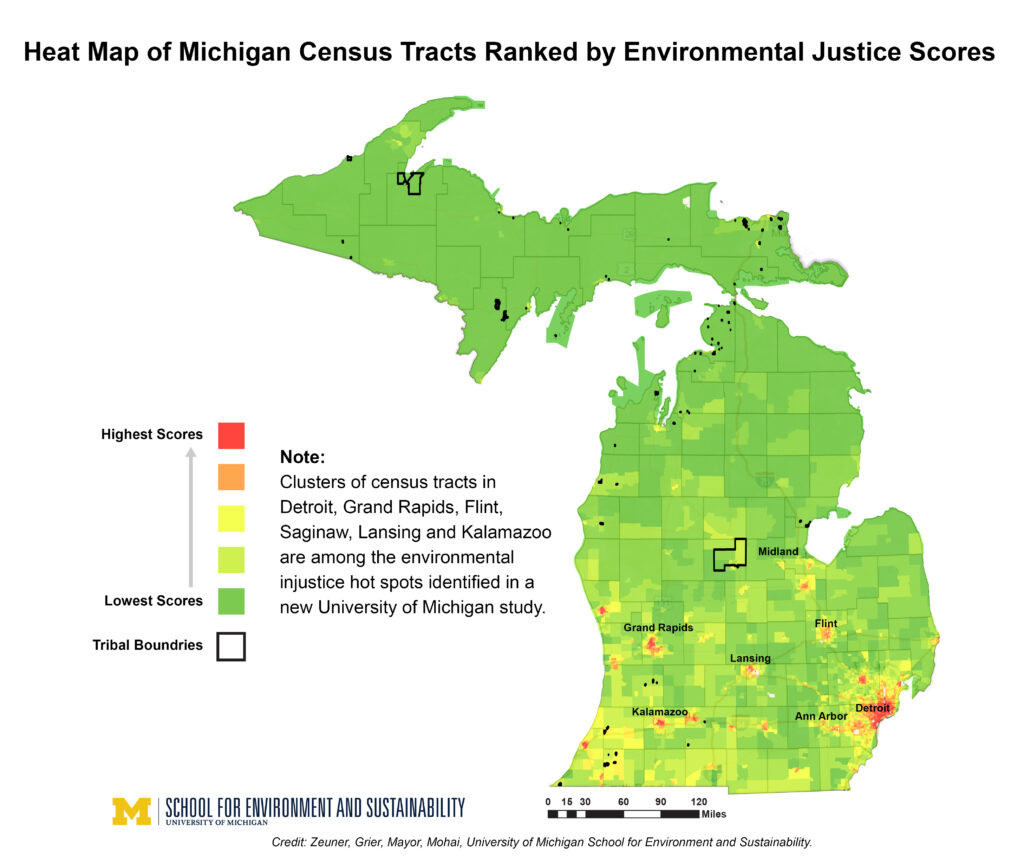
Students from the University of Michigan’s School for Environment and Sustainability created the heat map below with identified environmental injustice “hot spots” across the state. U-M professor Paul Mohai notes that these “hot spots” are home to large concentrations of minority residents, high levels of poverty and unemployment, low educational attainment, and other indicators of social disadvantage (source).
Today’s Challenge
Read
- Read The Atlantic’s coverage of the EPA National Center for Environmental Assessment’s 2018 report that showed how people of color are more likely to experience exposure to pollutants. https://www.theatlantic.com/politics/archive/2018/02/the-trump-administration-finds-that-environmental-racism-is-real/554315/
Watch
- Have you heard of environmental racism? Watch this video on how numerous systemic issues contribute to differences in exposure to potentially harmful environmental conditions. (3:33)
https://www.youtube.com/watch?v=dREtXUij6_c - Watch this video to learn how air pollution can weaponize the coronavirus. (9:02)
https://www.youtube.com/watch?v=XAFD-0aMkwE
Listen
- Listen to Mustafa Santiago Ali, former EPA staffer on why marginalized communities deserve a voice in environmental policy. (10:37) https://www.michiganradio.org/families-community/2019-05-07/former-epa-staffer-on-why-marginalized-communities-deserve-a-voice-in-environmental-policy