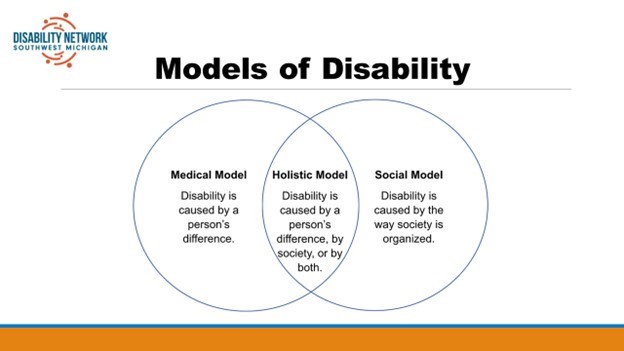
[Image description: A Venn diagram titled “Models of Disability” with two overlapping circles. One circle is labeled “Medical Model: Disability is caused by a person’s difference.” The second circle is labeled “Social Model: Disability is caused by the way society is organized.” The area where the two circles overlap is labeled “Holistic Model: Disability is caused by a person’s difference, by society, or by both.” Disability Network Southwest Michigan blue and orange logo in upper left corner of the image. Attribution: Disability Network Southwest Michigan (2024).]
The medical model, the social model, and the holistic model are three different ways of framing disability.
Most people outside of the disability community think of disability within the framework of the medical model, in which someone with a disability is thought to have an “impairment” that should be “fixed” so they can be as “normal” as possible. The medical model frames disability as negative and leaves little room for the individual to feel pride in their identity as a person with a disability. Many people with disabilities need medical care and treatment, but this does not mean they need to be fixed or that disabilities make them defective. Historically, the medical model of disability has viewed disabled people as incapable of living fulfilling, joyful, and independent lives. When viewing disability only through a medical lens, society fails to prioritize the changes to infrastructure, accessibility, and social supports that disabled people also need and deserve. It treats disability as the problem, while ignoring inequitable systems and institutions. Thus, challenging the medical model has been a large part of the disability rights movement.
The social model of disability proposes that disability is caused not by a person’s body or diagnosis, but by how society is designed and organized. This places no judgement on the person with a disability, and instead recognizes that societal barriers are the problem that needs to be fixed. If a person has paraplegia and cannot access a restaurant, it is not their paraplegia or their wheelchair that is the barrier—the lack of a ramp is the barrier. This shift in attitude from the medical model to the social model of disability creates an environment where people with disabilities are accepted as equal and valued members of society. However, the social model was originally designed to describe the experiences of people with mobility and sensory disabilities and is not fully inclusive of other types of disability, such as chronic illnesses or mental health disabilities.
The holistic model of disability is intended to capture the full complexity and wide range of disability experiences. The holistic model of disability proposes that disability may be caused only by a person’s difference, only by their interaction with society, or by both their difference and society in combination. Under the holistic model, people with disabilities can freely choose therapies and medical treatments that support their needs and goals, while also receiving the social support necessary to live their best lives.
The shift from mere awareness of disability to full acceptance of people with disabilities requires society to take responsibility for creating accessible and inclusive communities, systems, and institutions

Read
- ASAN: Acceptance vs. Awareness
https://autisticadvocacy.org/2012/04/acceptance-vs-awareness/
- Introducing the Holistic Model of Disability
https://autistictic.com/2020/02/14/the-holistic-model-of-disability/

Watch
What is the Social Model of Disability (3:07, includes captions)
https://www.youtube.com/watch?v=0e24rfTZ2CQ
Listen
- NPR: The Social Side of Stuttering (15:00) https://www.npr.org/2021/01/19/958423970/the-social-side-of-stuttering
- (transcript): https://www.npr.org/transcripts/958423970)
Discussion
- Is the social model of disability a new concept for you? What do you think about it?
- When you encounter people with disabilities, do you find yourself feeling that they are “broken”? How could you shift your thinking to a more social model?
- What barriers have you seen in your community that prevent the inclusion of people with disabilities?