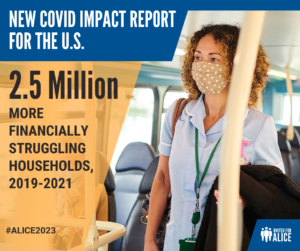

Lower-income people struggled in the face of the COVID-19 pandemic compared to financially stable households, according to a new analysis.
“The Pandemic Divide: An ALICE Analysis of COVID Surveys” found a much higher percentage of lower-income people struggling to get by, having lost jobs and income, and wrestling with depression and anxiety. The report comes from United For ALICE, a United Way affiliated research and action effort around financial hardship. ALICE stands for Asset Limited, Income Constrained, Employed—households that strain to make ends meet, have little or no savings, and typically don’t qualify for public assistance.
“Even with the added protective measures of eviction moratoria and housing and food assistance programs, conditions worsened for households below the ALICE threshold from March 2020 to May 2021,” the report states.
ALICE families were more likely to:
- Fall behind financially;
- Lack savings and assets;
- Face job disruptions, from layoffs and furloughs to work barriers such as lack of child care
- Suffer more physical and mental health issues;
- Struggle with other needs, from poor access to food to inadequate technology for kids who were schooling from home.
“It is precisely the challenges that ALICE families were facing before the pandemic that made them so vulnerable to the health and economic crises of COVID-19,” according to the report. “Before the pandemic, ALICE households already faced persistent challenges related to income, basic expenses, employment, and savings and credit, and for many households these issues were compounded by systemic racism and discrimination.”

Chris Sargent, President & CEO of United Way of the Battle Creek and Kalamazoo Region, said the new report underscores the urgency of United Way’s work for a financially stable region.
“Thirty-nine percent of our area’s households don’t make enough to exceed the ALICE threshold, the income needed to be financially stable,” said Sargent. “That needs to change. A community that thrives socially, economically and culturally is one where all people have equitable opportunities and supports to succeed.
“That’s where United Way plays a key role. We’re specifically built to bring together the partners, programs and resources to address the unique, complex issues that plague ALICE families. The pandemic underscores the importance of driving that work forward,” he added.
To read the full report, click here. For details on how United Way makes a difference in the Battle Creek and Kalamazoo region, check out our most recent impact report. Please consider supporting our work by making a donation today.